
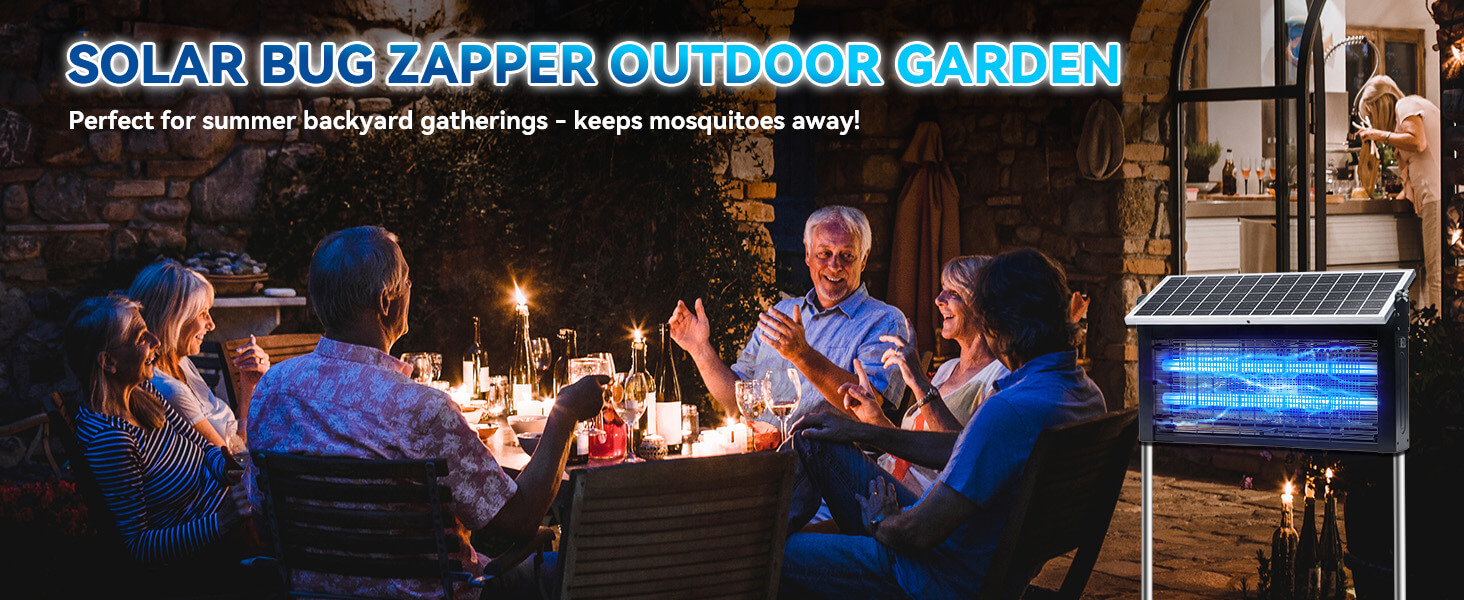
You know that moment when you finally sit down on the patio after a long day, drink in hand, ready to relax—and then you hear it. That high-pitched buzz right next to your ear. Yeah. Mosquitoes have a way of ruining outdoor time faster than just about anything else.
We tried all the usual stuff over the years. Citronella candles that barely worked. Sprays that smelled like chemicals and made us wonder what we were breathing in. Those plug-in zappers that meant we had to run an extension cord across the yard. Nothing really clicked.
Then last summer, we decided to try a solar powered bug zapper. Not one of those cheap ones you see online that look like a toy—we did some research and found one built with some real thought behind it. Here’s what we learned about what actually makes these things work, and why the one we got has been a game changer.
What We Found Actually Matters in a Mosquito Killer
Turns out, not all bug zappers are created equal. After reading through a bunch of forums and product specs, we realized there are four things that separate the ones that work from the ones that don’t.
1. The Light Wavelength Matters More Than You'd Think
Most cheap zappers use 390NM LEDs. They glow purple, they attract some bugs, whatever. But we learned that mosquitoes are actually way more drawn to 365NM light. It’s a specific UV wavelength that just… works better.
Ours uses UV 365NM LEDs, and the difference was noticeable right away. The first night we turned it on, it was catching stuff we didn’t even know were in the yard. You can actually hear it doing its job.
2. Voltage = Instant Death (No Half Measures)
Here’s the thing about lower voltage zappers—sometimes the bug just gets stunned. It hits the grid, sparks a little, and then falls down and flies away later. Gross, right?
Our unit runs at 3000-3500V. The ones we looked at before buying were mostly around 2500V. That extra voltage means when something touches the grid, it’s done. Instantly. No half-dead mosquitoes crawling around later.
3. Battery Life That Actually Lasts All Night
This was a big one for us because our yard doesn’t get full sun all day. We have trees, so some spots are shaded. We needed something with efficient solar panels and a battery that holds a charge even on cloudy days.
The one we got uses high-efficiency silicon panels and a LiFePO4 battery—that’s lithium iron phosphate, which apparently lasts way longer than standard rechargeable batteries. On a full charge, it runs for over 14 hours. From dusk until well past dawn. We’ve never woken up to find it dead.
4. You'll Want to Clean It—So Make It Easy
This is something nobody tells you about bug zappers: they get gross. Dead bugs accumulate. Dust covers the solar panel. If you can’t clean it easily, you’ll stop using it.
Ours is fully waterproof, so once a week I just spray it down with the hose. Takes 30 seconds. The solar panel stays clean, the grid stays clear, and it keeps working like new.
Why Solar Just Makes Sense
Honestly, the solar part is more convenient than we expected. No cords. No outlets. No remembering to turn it on at night—it has a light sensor, so it just… starts working when the sun goes down.
We also like that there’s zero chemicals involved. We have a dog and little kids running around, so not having to worry about sprays or toxic fumes is a relief. It’s just light and a metal grid. Simple.
A Few Tips If You're Thinking About Getting One
After using ours for a full season, here’s what we wish we’d known from the start:
Placement is everything. Put it near where mosquitoes hang out—bushes, shady spots, near water—not right next to your chair. You want to lure them away from you, not toward you.
Keep it away from other lights. If there’s a brighter porch light nearby, the zapper loses. Make it the brightest thing in its corner of the yard.
Clean it regularly. I know I said this already, but seriously—set a reminder. A dirty zapper is a useless zapper.
Bottom Line
We were skeptical at first. Another gadget? Does it actually work? But after a summer of actually using our patio without getting eaten alive, we’re converts. The right solar mosquito killer—one with good wavelength, high voltage, solid battery, and weatherproof build—makes a real difference.
If you’re tired of spraying chemicals everywhere or tripping over extension cords, it’s worth looking into. Just get one that’s built right.